When an eight-year-old girl gave me unprompted advice about skating, I knew I was laughably bad.
“Keep your feet close together,” she said in passing.
For a sports writer, that was humbling. I’d never covered hockey. But I’ve become jaded by the very thing I love. Between the transfer portal, untapped spending by juggernauts in Major League Baseball, and the rising cost of ticket prices and streaming services, the games don’t feel the same.
As a kid, sports created joy and satisfaction. Playing a new sport is how many children encounter challenges and learn new skills, because games should be about growing people, not pockets. And I wanted to recapture the feeling sports had as a child. So, I set out to try hockey — something I never did growing up.
A childhood experience of falling and getting my finger sliced by my friend’s skates had mostly kept me off the ice. I was content with my funnel cake in the cafe. But my first-grade brother plays hockey, and National Hockey League ratings are high — in 2024, viewership was up 7% for the most-watched season in 30 years, according to the Associated Press. It became my duty as a sports writer to explore hockey, especially in the cold Midwest, where it’s a favorite. I knew it wouldn’t be easy.
“I did not like [hockey] when I started because you get out there and you can’t really move and you see other people zooming around you and you’re just stepping,” said Parker Pederson, a club hockey player at Drake University, while moving his hands in a choppy up and down motion. “It’s definitely really difficult to learn at the start.”
As with any skill, I had to start with the basics: skating. This was an uphill battle. Mathieu Schneider Jr., St. Louis Blues coordinator of youth hockey development, said it’s harder to learn as an adult. And if you can’t skate, you can’t play.
“Attempting to play hockey without having the proper skating ability would sort of be like trying to play football or soccer before knowing how to run,” Schneider Jr. said.
I invested $11 in rental skates and a public skate, going to West Des Moines’ RecPlex at 1 p.m. on a Wednesday — perfect timing to avoid human interaction. I was wrong. There were at least 10 other people there, and the dread I felt on my drive to the rink became tangible anxiety.
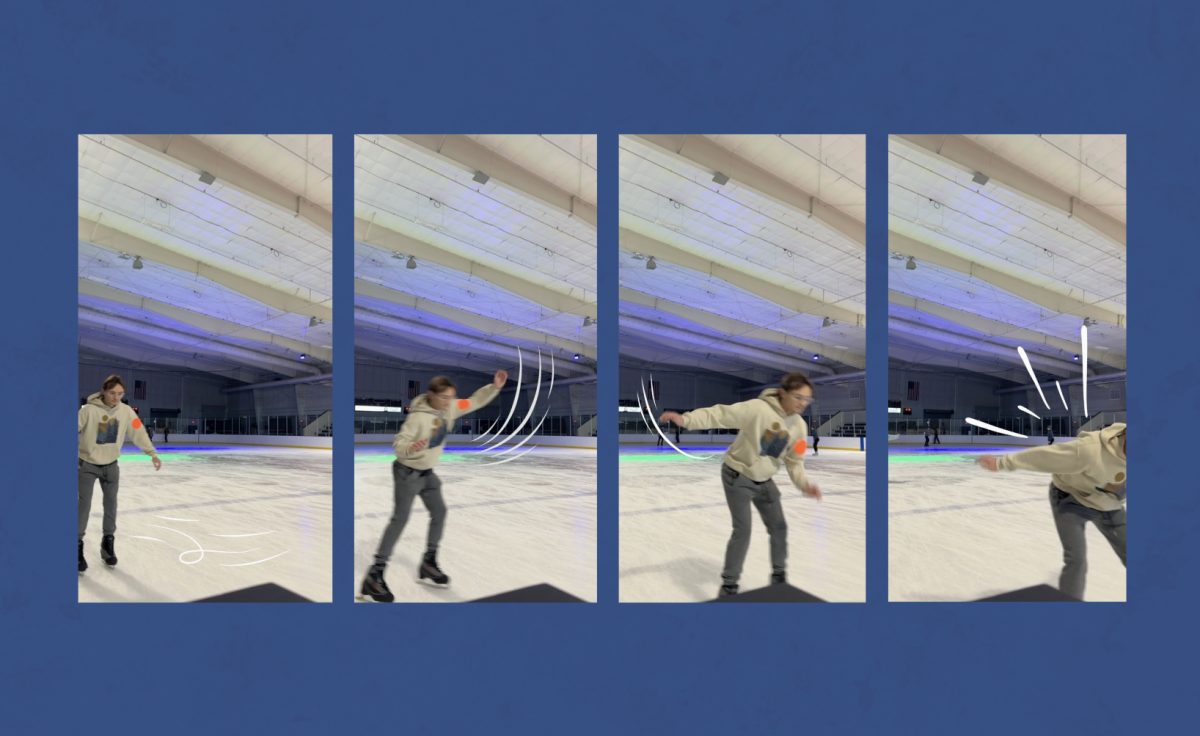
Before braving the ice, I enrolled in YouTube University. The videos made it look easy: learn how to do x, y and z in one minute. Tell that to the seven times I fell. Rate my professor: C. Helpful but unrealistic expectations.
My first few laps were challenging and tiring. Other skaters were gliding on ice, while I was chopping my feet forward, waving my arms around, questioning how others had such prowess on this foreign surface. I timed my perimeter journey and felt good until I lost balance and dove. I got up and trudged to the rink’s entrance: 00:57.25 for a single lap. I looked around, hoping for invisibility, and saw couples learning together, kids falling and experienced skaters developing new skills. Everyone was learning, and I felt welcome.
When I felt relatively comfortable skating, I then realized that I couldn’t brake without running into the wall. And to go fast, I needed to stop. I saw a family of four working on just this and asked for advice. I skated around the rink with their teenager, working to keep up and mask the exhaustion by slowing my accelerated breathing cadence. His family was learning together, and today, they were learning the hockey stop.
His brother skated by, pointed at his busted lip, saying, “This is what happens when you try the hockey stop.” Feeling timid to try after that, I received encouragement from my teenage teacher: “Just keep on trying; we’re all at different skill levels, and that’s okay.” When he skated off, I realized how much he’d slowed down to chat with me, while I’d been speeding up.
After an hour and a half, ice time was up. I’d made minimal skating progress, but I found unexpected enjoyment and community. For us Gen Zers, growing up online has made us wary of new human interactions, but I found encouragement from others. I took advice from that eight-year-old because, as a newbie on the rink, I had to humble myself and admit that I didn’t know anything. And just because I didn’t skate as a child doesn’t mean I can’t now.
My other time trials yielded 00:52.00 and 00:50.51. Slight improvements. On the way out, I asked an employee how competitive the drop-in hockey was. “Very.”
I’ll stick to skating.
I got home, and the Winter Olympics’ ice dancing was on television. I watched world-class athletes glide on the ice and understood how many hours they poured into their craft. They haven’t stopped learning. The child at the rink hasn’t stopped learning. And neither should I — even if my Achilles and my ego hurt a little bit afterwards.