My generation is the first to be considered “digital natives,” having grown up with far greater access to the internet and media as an integral, although often hidden, part of our lives. And technology has, broadly speaking, made our lives so much easier. Our phones have replaced physical alarm clocks, calendars, calculators and other things that don’t start with the letter C. If I touch my phone in the right places, a pizza will show up at the door.
But every generation has been impacted and transformed by the skyrocketing of generative artificial intelligence, and that impact extends far beyond making things easier. From the job market to academia, city government to legal briefs, AI is challenging the assumptions we once held about possibility and reimagining entire industries as we’ve known them. From the elderly who are now using chatbots like Google to the middle school students who are turning in AI-written book reports, AI is a tool that has been driven by a desire for convenience — that’s human. We’re all impacted.
I don’t know enough to write about all of society, but I can write about what I’ve seen in my own life. I’m incredibly concerned about people’s brains.
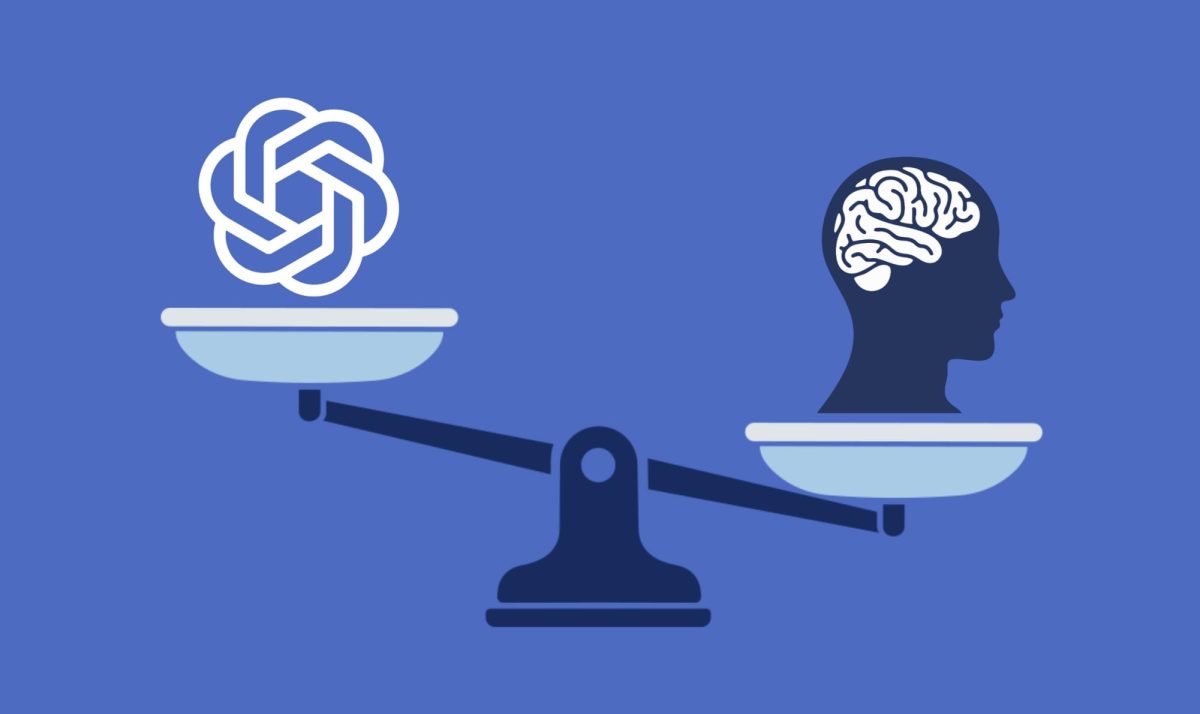
It’s not a debate — use of AI is empirically a cause of cognitive atrophy. It’s particularly exasperating to me to watch people use AI to make decisions.
Generative AI is now being used to make all sorts of plans: workout plans, meal plans, degree plans, study plans, social plans, etc.
This usage is insane to me because AI is such a subversion of human autonomy. Autonomy means making decisions for yourself. By using AI, we are literally choosing to make ourselves less capable. We are willingly eroding our own autonomy. We are incapacitating ourselves for the convenience that comes from not using our brains.
A lot of this type of AI use is driven by the belief that AI can do things either better or faster, or a combination of the two. Several months ago, a woman a few decades older than me asked me to read her cover letter and suggest improvements. I didn’t get past the second sentence before I hit Ctrl+A and Ctrl+C and dropped the whole thing into three different AI detectors. The result was unanimous: this content is 100% AI generated.
I didn’t bother reading the rest of the cover letter; why would I? I asked her to come back over for a second and silently clicked through the tabs. “So what?” she responded. She did not see the problem with using ChatGPT to write her cover letter. I was beyond angry that she had wasted my time by asking me to read something she couldn’t even be bothered to write herself.
One of the most insidious aspects of most chatbots is the inherent design to affirm, validate and agree. It’s an echo-chamber of self-affirmation. It’s also a suffocation chamber of critical thinking skills. Endless affirmation and an absence of challenge is a perfect formula for mental stagnation. I firmly believe that without challenge, there is no growth.
The sheer number of people I know who use ChatGPT as a therapist scares me. I understand the need to process emotions and feel validated. But please, for the love of cerebral functioning, write it in a journal, not to your chatbot. Talk to a friend or therapist, not a large language model. Speak to something (read: someone) that can give you a perspective that’s not your own.
AI is incapable of disagreeing with you. It only has your prompts and its training data to draw from; it’s incapable of independent, critical thought. How do we not realize how incredibly dangerous that is?
If you need a machine to agree with your feelings or thoughts before you can feel validated, then you need to reevaluate the underlying causes and logics that inform those things. This world is one fundamentally shaped by conflicting ideas, and it is imperative that we all learn how to hold our own.