
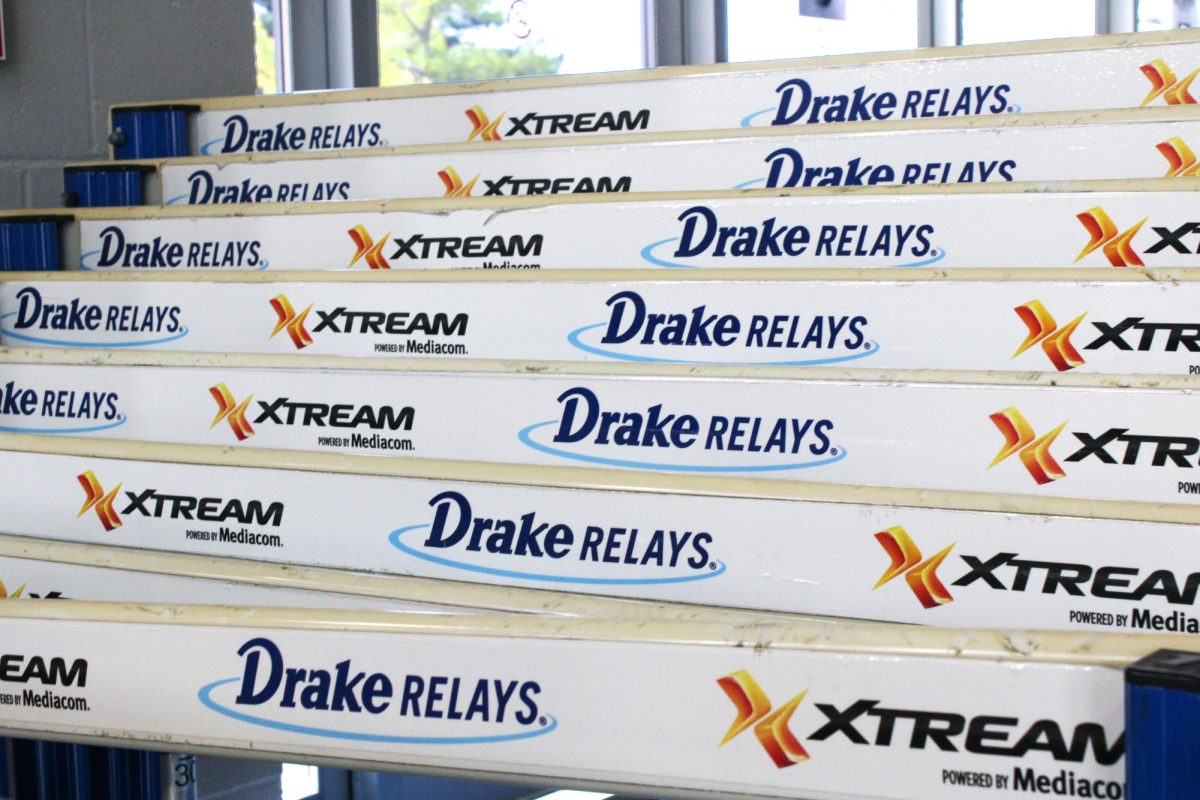
The Drake Relays is the biggest event that Drake University hosts every year. More than 5,000 athletes and 40,000 spectators come to Drake Stadium, according to the University website’s page on the event.
The planning for the next Relays starts as soon as the previous Relays ends, making it a year-round process. Associate Director of Relays Operations Tre Stanton works on the planning and setup of Relays.
“The scale of Relays is much larger than most people realize,” Stanton said. “It’s a multi-day operation involving thousands of moving parts.”
Stanton said that at the beginning of planning, the Relays team starts reviewing past Relays to see what they need to work on first, like confirming key contracts, updating bid lists, securing dates on calendars and getting big rentals secured.
Director of Facilities, Events and Operations Hannah Onken is familiar with the set up process closer to Relays.
“We are starting to order and get quotes for rentals we usually have each year about three months out,” Onken said.
During this time, the Relays team works on finalizing event schedules, meet entries, major vendor needs, credentialing systems, security coordination and sponsor activations, mostly based on past meets but also including what they want to improve on.
“One month out, detailed planning accelerates and the final logistics are locked in,” Stanton said.
In the month leading up to Relays, the team gets more detailed with preparation. They do the final checks of the equipment, acquire rentals, hospitality and signage, and assign volunteer positions.
There are many things that the athletics department has to order in specially for the Drake Relays. This includes items such as generators, lighting, timing technology and meet-management systems, as well as portable toilets, tents, bike racks, barricades and even golf carts.
“The Relays require a significant amount of temporary and specialty equipment that isn’t used during the rest of the year,” Stanton said.
Most of these items are determined based on what Drake had or needed at last year’s event and how many athletes are attending this year.
During Relays, the department uses more space than just the track. One of the most important spaces they use is the Knapp Center. They use it as a space for teams to check in and to give out credentials for athletes, workers and media personnel. It is also used as a training space for athletes, a warm-up space before events for college and professional athletes and overflow for meet operations.
Assistant Director of Facilities, Events and Operations Teddy Foley said the team uses the Fieldhouse, Mediacom Stadium and the Roger Knapp Tennis Center at various points during the event.
“The Fieldhouse is used on the Wednesday night of Drake Relays week for the World Shotput Championships, that is a very cool event,” Foley said.
The Fieldhouse is also used for weather contingency needs. Another place the Relays use is Mediacom Stadium and the Bell Center for warm-up areas for high school and college athletes. The Knapp Tennis Center tennis courts are used as a campground for schools during the week.
Some events occur away from campus. Franklin P. Johnson Director of the Drake Relays Blake Boldon said that the pole vaulting event will be returning to Jordan Creek Mall.
“Vault at Jordan Creek is such a special showcase of athletic excellence and community engagement, and we’re excited to see this elite indoor pole vault competition return,” Boldon said.
According to the athletic department, physical setup starts during the Jim Duncan Invitational, a high school meet that happens two weeks before the Drake Relays. One of the main vendors for set up is Event Decor of Iowa. A week out is when they bring in most of the outside equipment and start focusing on Relays specifically. They continue to set up until Wednesday evening before the first events start.
“There is a lot of planning and preparation that people don’t know about,” Onken said. “Talking about portable toilets isn’t something I thought could be as large of a discussion as it is.”
Planning has to be timed out to the minute for TV coordination and event-to-event equipment transferring to make sure everything stays on schedule and the meet flows smoothly.
“It’s a multi‑day operation involving thousands of moving parts,” Stanton said. “Radio communications, athlete flow, medical readiness, security, parking, transportation and constant venue resets all happen simultaneously.”
Most of these operations begin hours before the gates open and continue long after competition ends.
“The meet succeeds because of year-round planning and a deeply committed community that supports this event every spring,” Stanton said.