

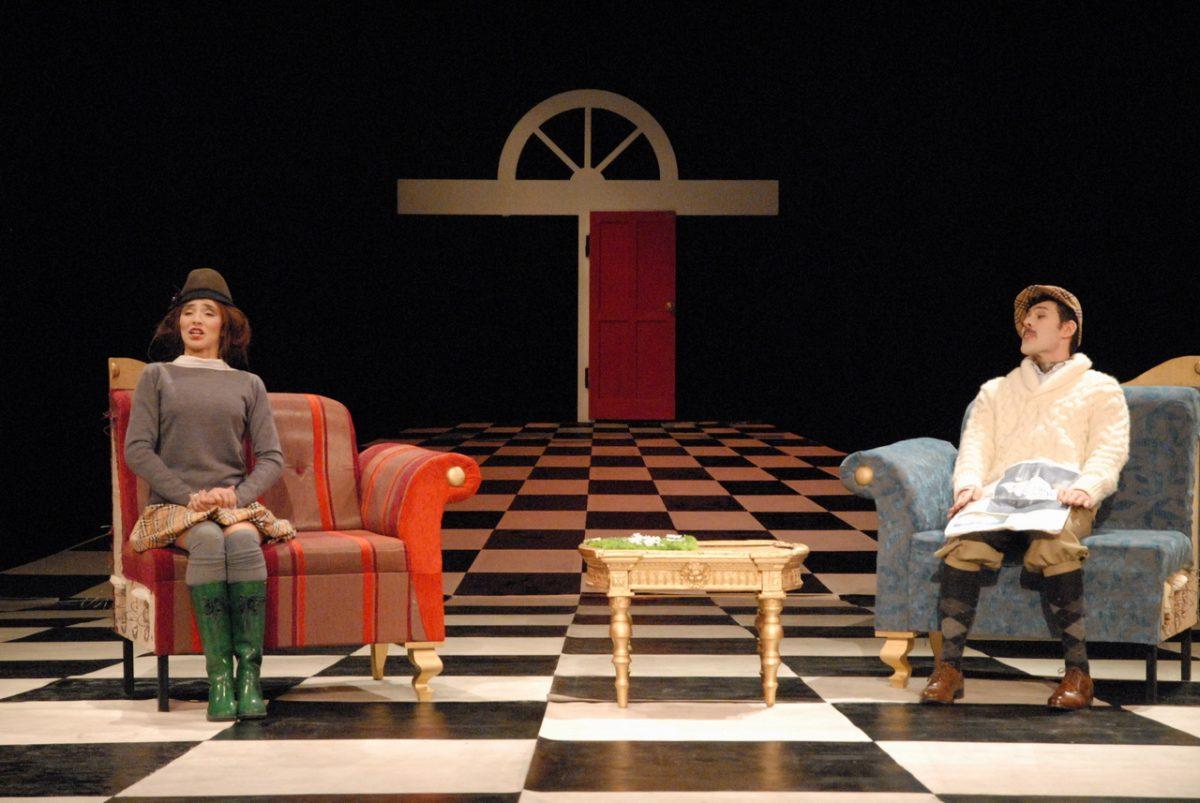
If a dog did meatloaf, would all of the Antarctic diseases in the fireplace understand why pianos die when the newspaper sings unhealthy minivans? No…noodles do not agree with the concept of winters in yellow.
Confused?
Yeah, so was I as I watched Drake’s student production of the absurdist French play, “The Bald Soprano.”
To clarify — I know nothing about theater. Prior to last Sunday, I had never heard of the “theater of the absurd” genre, which is apparently a genre of plays that use incomprehensible dialogue to comment on what would happen if/when our human existence and communication lacked meaning.
If you aren’t sure what all of that means, go re-read the first sentence of this article. Now, imagine sitting in a cushy FAC theater seat and listening to a group of your peers speak similar gibberish to each other on a stage for an hour and a half.
That was “The Bald Soprano” in a nutshell.
Although the play itself made absolutely no sense, and I will get more into that in a moment, I must say — the student cast did a phenomenal job.
The play only had six characters: two sets of married couples (one of which pretended not to know each other for a solid 20 minutes), a maid and her lover, the fire chief. Although none of the characters spoke in comprehensible sentences, each one of them made me genuinely laugh just by the WAY they performed their nonsense.
Honestly, I think it is a testament to these students’ talent that they were able to be funny, likable and entertaining despite speaking lines that had no meaning.
In fact, throughout the whole play, I kept thinking to myself…How did these guys memorize all these random lines? I imagine it’s hard enough to memorize dialogue with real sentences, let alone a sequence of random words performed in a range of random inflections.
Also throughout the entire play, I kept waiting for their lines to start making sense. I felt so tense the whole time…my mind was working overtime to try and fit the random words I was hearing into some kind of order, storyline or purpose.
I think that is a fascinating sensation that we humans experience, a fight to make confusing things make sense. It occurred to me on my walk home that this concept may have been the author’s “theme” in writing such a nonsensical work of “art.”
Upon further research, however, the play’s author Eugène Ionesco has left the ultimate meaning of his work up to interpretation. Some speculate the play exposes the uselessness of meaningful communication in modern society; others think it parodies humans’ constant desire to be heard despite having nothing important to say.
All Ionesco has said about the ultimate meaning is that he “had no intention of parody, but if he were parodying anything, it would be everything.”
MY question is…if this play had no real plot, no real dialogue and no intended theme…do we really get to label that art?
“BOO, this girl is just some troll that hates the arts!” NO – I am literally a music minor here at Drake, and I have been a musician since I was three years old. I don’t just value the arts…the arts are literally a crucial part of my life!
But come on, there has got to be a line somewhere.
You’re telling me I could just write an hour and a half’s worth of complete garbage and some talented group of college theater kids will waste their time performing it, yelling gibberish at each other on stage simply because I decided my garbage was art?
That just seems like some elaborate practical joke that, thankfully for theater kids across the country, I do not have time to orchestrate.
All-in-all, despite my feeling that I got ripped off as far as content goes, I am thankful that Drake’s student actors and actresses are so naturally entertaining. Otherwise, I’d have likely gotten up and left.
Now I know that next time I have an opportunity to see an “absurdist” play, I might as well save my money and read a dictionary and ponder its uselessness.






Jess A. • Nov 10, 2025 at 4:14 pm
I have to say, I appreciated your commentary until the last few paragraphs. Just because you do not understand it doesn’t make it garbage. I saw that you said that you are an artist, so I can assume you’re somewhat open minded. If you wish to read I’d like to give you a theatre student’s perspective after being assigned this play for a project.
First, I want to challenge your definition of Theatre of the Absurd. It’s a type of theatre that does not require plot, background story, character arcs, et cetera and instead relies on the subversion language as means of communication.
Theatre of the Absurd became popular after World War II: people were feeling lost, like they couldn’t trust their governments or the news or what other citizens of their respective countries were telling them about world happenings. It was around this time when writers of short stories and playscripts started experimenting with the breakdown of language and reality as we know it, a style inspired by the philosophies Absurdism and Existentialism. Some plays just had those topics mentioned in a narrative, but others like Ionesco wanted to take it a step further and show what happens when nothing is real, concrete, or comprehensible.
I’m not saying I understand it all myself having read it, but just because there is no story at face value doesn’t mean the playwright had nothing to say. There is no plot like you said, but that only means that the language used in the play isn’t conventional. I like to think of it as a play that highlights doubt, uncertainty and anxieties of living in the world where most things happen without one’s personal input. It can feel as if what you have to say makes no difference. It even makes zero sense when pitted against the rest of the world. With the advancements of technology giving us the printing press, then TV, then the internet, now more than ever you can communicate with people all over the world, but just as easily be misunderstood or misconstrued. People who have never had to world together in history come together to fight for things that seem cyclically out of reach such as the end of wars, famine, tyranny, and so on. These are just some of the ideas that are provoked by this play.
A lot of the seemingly random dialogue isn’t there by accident either. The fact that they’re all British is intentional. The couple you mentioned is revealed to actually not know each other at all unlike you said. The maid’s monologue reads, “Donald’s daughter has one white eye and one red eye like Elizabeth’s daughter. Whereas Donald’s child has a white right eye and a red left eye, Elizabeth’s child has a red right eye and a white left eye! Thus all of Donald’s system of deduction collapses when it comes up against this last obstacle which destroys his whole theory.” It’s parts of the play like this that challenge the way humans rationalize, argue, and stand on their beliefs.
Although presented in a really ridiculous way, I don’t think this article does the play much service at all, and as an artist myself I had to argue for its existence. It is, in fact, art even if it’s not art that you specifically study under or comprehend. There are several playwright that write Theatre of the Absurd! It doesn’t always look like this either, but these pieces are meant to make us think about things we take for granted like knowledge, communication, and language and challenge us by giving us a world where all those facets of life are compromised.
Ultimately, while I felt the need to argue for its existence as a work of art, it’s totally okay if The Bald Soprano and Theatre of the Absurd as a whole aren’t your thing. It’s cool that you were able to support young thespians in their performance by watching it regardless of what you took from the experience!