
The Times-Delphic conducted its annual anonymous survey for all Drake University faculty members to answer from March 30 to April 10.
This survey, sent out through email, asked questions related to the budget, salary, safety, burnout, morale, benefits provided by the University, artificial intelligence, communication and enrollment. No respondents were required to answer any questions, nor give their name or disclose their position.
This year’s survey had a total of 30 respondents by the time it closed. Not all respondents answered all questions.
Program and faculty cuts aren’t helping budget concerns, faculty say
Two years ago, Drake’s Board of Trustees eliminated the religion major, the East Asian studies minor and the graduate certificate in evidence-based health care.
The decision was an effort to alleviate the budget deficits caused by low enrollment at the University. In 2024, religious studies professor Brad Crowell’s position was eliminated. He moved his position to law, politics and society. Crowell told The Times-Delphic in 2024 that Drake’s administration is “seeking to eliminate the tenure of professors” who have remained at the University for “decades.”

Of 29 respondents, 37.9% said the program cuts were either not effective or not at all effective in alleviating budget concerns. One respondent, who answered not effective, said the cuts have made faculty hesitant to stay at the University.
“Some people are stuck here because they can’t find other jobs or they have spouses who can’t move because of their jobs, and so they are trying to keep their spirits up and survive until retirement,” the respondent said. “The current budget responses continue this trend. It is unpleasant working at a place where no one is invested in the place or the people they work with, and the way the administration runs the place encourages this.”
One survey respondent said the solutions to the budget deficits don’t always have to be cuts.
“If there is a need to cut staff, don’t just hire in other areas; it is difficult to weigh where there have been cuts and additions,” the respondent said. “It feels like there is not a plan. [Administration needs to] consider budget challenges over five-year periods, rather than an immediate need to cut.”
Of 29 respondents, 34.5% said the cuts moderately alleviated budget concerns. One respondent said cuts can be beneficial at the administrative level, but they don’t account for faculty morale.
“If you cut at everything, including positions, and don’t pay people more, eventually you will alleviate some of those budget concerns,” the respondent said. “Does a sparse university with grumpy employees and less diversity in course offerings make Drake a place students will want to attend?”
As both program and faculty cuts continue, one respondent believes the University is losing its variety of programs, students and faculty.
“A university can’t cut its way to wellness: growth and diversity of programs and offerings are the best signs of strength and health at a university,” the respondent said.
Of 29 respondents, 24.1% said the cuts were somewhat effective in alleviating budget concerns, and one respondent said the cuts were very effective. One respondent said cuts are often necessary in situations where budget deficits need to be fixed.
“I think faculty need to understand the reality around the competition for resources,” the respondent said. “If your program can’t sustain enrollment or find new revenue, then you need to be actively finding ways to make changes and not placing the burden on administrators to ‘fix it.’”
Future budget cuts are a concern within smaller schools in the University that have already faced issues, according to respondents. This uncertainty left some respondents wondering what is next for them and their schools amid these changes.
“I have seen two additional programs discontinued in my college that were not discontinued in the first round of reviews in Faculty Senate,” a professor of pharmacy practice said. “Now there is just pressure to remove these programs voluntarily.”
Enrollment and admissions are the biggest considerations in these cuts, according to several respondents.
“If admissions data continue to be below expectations, then I imagine we will eventually need to cut more programs,” one respondent said.
Of 30 respondents, 40% said the administration has handled the budget issues either poorly or very poorly. A respondent who answered very poorly believes a lack of accurate budget planning is a large factor in the issue.
“Every single year, the administration over-estimates the number of first-year students and under-estimates the discount rate, [which] reduces the amount of tuition per student. So, we end up in a budget crisis,” the respondent said.
43.3% of respondents answered moderate, with one also noting a lack of planning.
“I don’t feel like there is an overall strategic plan and prioritization system,” one respondent, who answered “moderate,” said. “It seems to me that those with status preserve duplicative resources, attractive and functional classrooms and offices, while those without status function in an environment of austerity.”
Only one respondent believes the administration has handled budget issues very well.
“I think we’ve faced a lot of challenges and admin has been creative and transparent,” the respondent said. “I think budget concerns can happen anywhere, and people need to remember that when economic factors impact a place like Drake, we aren’t always left with great choices.”
Reduced contributions to retirement have forced personal budget alterations, survey says
In spring 2025, Drake’s Faculty Senate cut contributions to faculty retirement benefits from 8% to 7%. Jerrid Kruse, the president of Faculty Senate, told the TD last year that “there’s only so much money available and decisions have to be made” regarding decreasing employee benefits.
Respondents of last year’s faculty survey reported having to closely examine personal and retirement budgets out of fear of further program cuts. With the reduced retirement contributions, respondents of this year’s survey expressed similar sentiments.
“I have to constantly rework my personal budget, and I’ve reduced my retirement contribution minimally,” one respondent said. “It is not sustainable, and the administration will have to address faculty compensation and the cost of the University’s healthcare, which increases most years.”
Several respondents said the cuts have forced them to change their retirement age and consider pursuing ot
her job opportunities.
“I am considering leaving academia when I can still work full time for a decade to try to regain losses,” one respondent said. “I also am looking into a part-time job that I can have as a backup now — but could be my escape plan in a few years. I don’t think I can retire until age 70.”
One respondent said they’ve seen their colleagues face similar issues.
“The worry that I will [work] until I am 75 sometimes wakes me up at night,” the respondent said. “I have seen this happen to several senior colleagues who are not here anymore. I feel bad for them and worry that I will have the same thing happen to me because pay is low, retirement contributions are low, and the price of everything keeps rising.”
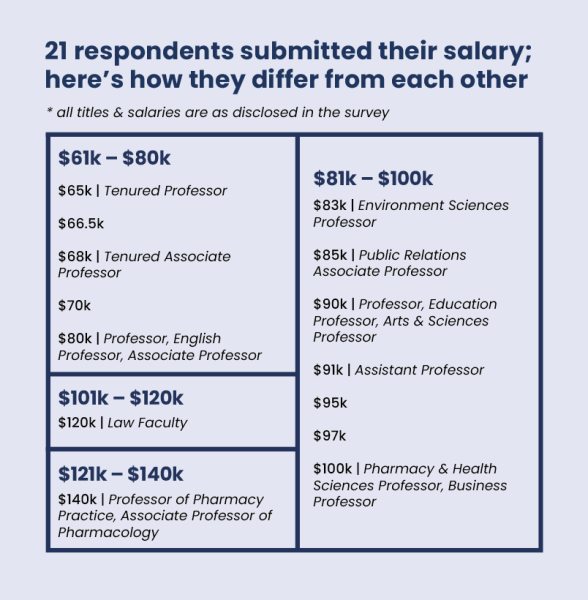
Faculty find current salaries not reflective of value to the University
Provost Sue Mattison said in an email to faculty in September 2022 that the University had moved all faculty salaries to at least 85% of the median salary of peer institutions. In April 2023, the TD sent out an anonymous survey to all faculty members about salaries. Among 60 respondents, many faculty members said the last raise was four or five years prior.
Those findings are consistent with this survey’s results. Due to budget reductions in the past year, the TD reported that faculty salaries would stagnate.
“They cut our summer pay several years ago by thousands of dollars and there haven’t been any real raises in years. I make less in 12 months now than I did 10 years ago,” one respondent said.
Mattison explained in March 2023 in a Faculty Senate meeting that when faculty members’ salaries reach 85% of the median, it means the salaries are at the minimum of the competitive range.
“Most faculty have not received any kind of raises for three years now,” one respondent said.
One respondent has hopes for future leadership regarding salary.
“I hope the new Provost will push back against the president and board of trustees to get a cost-of-living increase passed for faculty and staff,” they said.

Of 30 respondents, 60% said their current salary is either not reflective or not reflective at all of their value to the University.
“When I think about the credentials and skill set that I need to do my job effectively, and the experience I bring as someone who has worked here for over a decade, I cannot believe I only make 68,000,” one respondent, who answered not reflective, said.
30% of respondents answered moderately reflective.
“I feel undervalued in more ways than salary — that is reflective of challenging times, but there are numerous other ways to feel valued and those intangible aspects are lacking,” one respondent, who answered moderate, said.
Three respondents said they believe their salary is reflective. No respondent said their salary is very reflective of their value to the University.
Remaining faculty concerns
Other topics covered were artificial intelligence, safety on campus, morale and communication from administration.
Many survey respondents reported not just a lack of understanding, but a lack of training regarding AI.
Of 30 respondents, 56.7% said the administration has prepared faculty to use artificial intelligence within their department either not well or not well at all. 23.3% of respondents answered moderate, 20% answered well and no respondent answered very well.
“With the rate of change, direct mentoring is needed to assist faculty in using AI ethically and efficiently to support work and alleviate increased teaching load requirements,” one respondent, who answered not well, said.
Another topic faculty discussed was morale and burnout. Last year’s faculty survey reported that burnout contributed to low morale and that they had to take on new responsibilities. Of 28 respondents, 60.7% of respondents reported their burnout had increased or significantly increased since last year. 32.1% of respondents said there has been no change. One faculty member who responded moderate said they’re “equally tired, frustrated and despondent as [they] have been.”
When asked whether they feel as if they can delegate responsibilities in their position, one respondent simply answered, “To whom?”
Serena Thiede contributed to writing and reporting.