
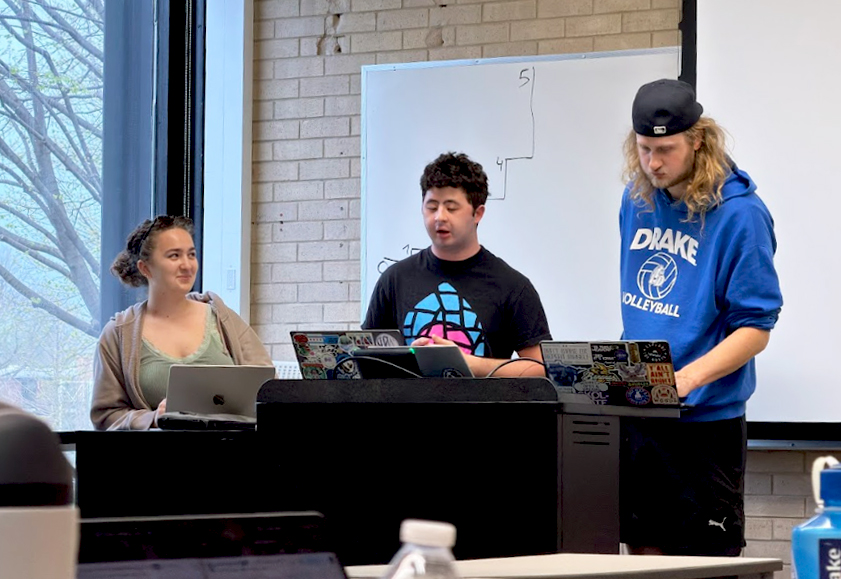
A typical class for students in the Research Seminar in Immigration Policy begins with up to 10 minutes to talk about deadlines. The students have to keep Institutional Review Board approval, conference applications, registration and other timelines in mind before they start their research. But from there, Adrien Halliez, an assistant professor in American politics, lets the groups work on their own.
“It’s a process of being more assertive for the students, being more self-confident about what they can do,” Halliez said. “And yeah, it takes a little bit of time to get to that level of confidence, but they’re doing good.”
Research Seminar in Immigration Policy allows students to take on a group project on the subject all on their own. This is the second iteration of a research-based course throughout the semester.
This semester, the class has the goals of attending a virtual conference hosted by Illinois State University, getting research papers published and hosting a presentation on the topic.
The topic, immigration policy, came from both Halliez’s field of research and student interest after Immigration and Customs Enforcement agents killed two people in Minneapolis. While some aspects of immigration policy had been well-explored, said Halliez, such as surveys on public sentiment towards ICE from the Pew Research Center or Gallup, few studies have gone beyond that.
The class broke into three groups early on in the semester, each with a different project related to immigration policy.
One group is examining rhetoric in the U.S. Senate regarding immigration bills such as “Angel Moms” — bills for mothers whose children were killed by undocumented immigrants — and floor debates.
Another group uses observational surveys to explore moral foundation theory, including predictors of attitudes toward immigration enforcement.
The third group is exploring how the media impacts attitudes toward immigration.
While the class had funding from the Slay Fund for Social Justice to run two surveys through the software Prolific, they had to apply for $1,000 in one-time funding from Student Senate. CJ Villarreal, a second-year studying politics and data analytics, is participating in the group studying media. He presented the funding proposal to Student Senate.
Prolific will allow the group to send out the survey to a national audience, creating results from a goal of 800 participants that Villarreal looks forward to working with.
“I want to be able to try and break that down,” Villarreal said. “What I want to do after college is be a data analyst or something [in] politics. … I’m just really excited to get the survey out and then see what the data looks like coming in.”
Prolific requires survey participants to be paid $8 per hour. Villarreal’s group is aiming for surveys to take 7-10 minutes, meaning participants would earn around a dollar for taking it. The survey would present participants with headlines regarding immigration and attempt to measure a change in their perception of immigration issues.
Villarreal hopes that the class sets a precedent for future groups of students.
“Maybe other students who are interested in either this class or next year, next semester, they would get the same opportunity that I did to do their own research in something different,” Villarreal said.
The research requires not only hours of thorough digging but also communication between group members in and out of class time. To communicate, the class uses Slack and creates specific goals to accomplish each day. Halliez provides advice for the groups as they continue to work.
“I always tell them you want to give a reason to your readers why they should stick with what you have to say, what’s your contribution, instead of branching out and going to check out one of the articles you’re citing,” Halliez said.
While Halliez helped the class during the literature review stage of the project, where they were focused on researching the subject, the class’ goal is independence.
“[I’m in] a role that tends to disappear progressively as the weeks go by,” Halliez said.
Whether the work is publishable depends on the results and the continued work, but Halliez believes the class has a fair shot. But Halliez believes the most important takeaway for students is an understanding of data and how it is collected, no matter what field they enter.
“Data sounds like the most objective thing ever. That is not the case… ” Halliez said. “[Artificial intelligence] has biases built into how it’s analyzing data. Human researchers do as well. …It’s okay to have them, but be honest about those limitations that you may have.”
The class has a presentation scheduled for April 30 with political science academic fraternity Pi Sigma Alpha.