
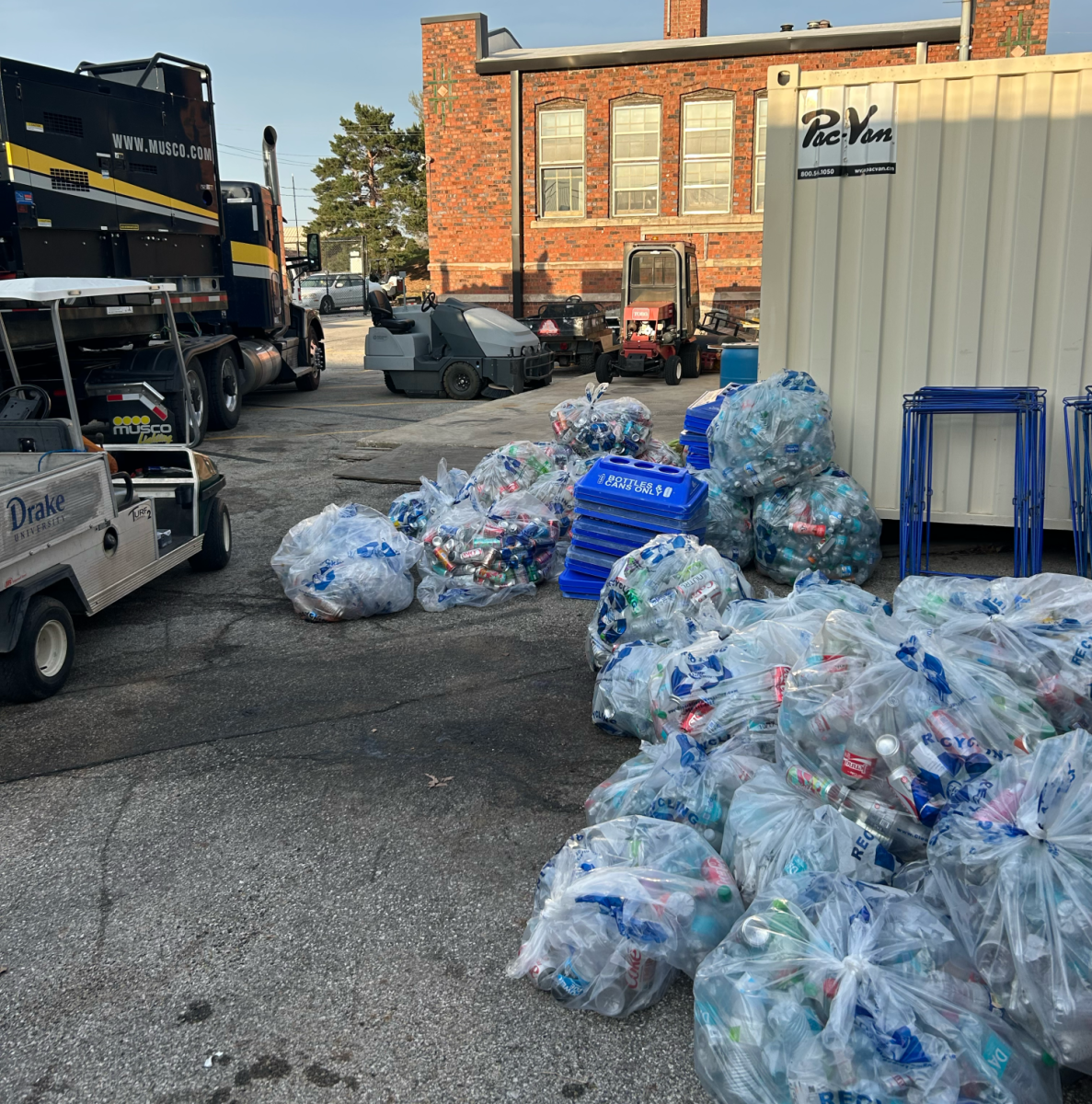
In Herriott Hall at Drake University, the blue recycling bin fills quickly — but not with recyclables alone. Half-finished Starbucks drinks, dirty plastic food containers, melted ice and food waste mix with reusable paper and cardboard material, contaminating everything inside. When a custodial worker arrives, there’s little decision to make. The entire bin is lifted, tied off and rerouted to the trash.
“From facilities and grounds to campus dining, we utilize products and practices that cut down on environmental harm and unnecessary waste so we can minimize Drake’s impact,” reads Drake University’s Sustainability page.
The Office of Sustainability at Drake highlights its commitment to sustainability through a campuswide recycling initiative, seen with the blue rectangular bins across campus. The office has a 10-year sustainability plan laid out to the public, but sources on campus say the plan’s execution lacks awareness and effort in creating a truly effective green campus.
One of those sources includes a Drake custodial worker, who requested to remain anonymous. They and their coworkers complete the same procedure every day when changing the trash and recycling around campus, including buildings and dorm halls.
“We take it outside by the trash dumpsters and we empty it there,” the custodial worker said. “After that, the ground staff come to collect it [and drive it to the local recycling collection facility.]”
The worker said that even though the campus has two separate bins, blue dedicated to recycling and black to trash, many people still throw contaminated or non-recyclable materials in the recycling containers.
“There are a lot of people who do not pay attention to what is trash and what is recycling,” the custodial worker said. “Sometimes people put food containers with sauce or coffee cups in them. So they go on the papers and everything in there, so we have to throw [the whole bin] away as trash.”
Sydney Dvorak, a 2025 Drake graduate and the University’s sustainability coordinator, said that she views Drake’s sustainability culture as more of a grassroots effort across campus, not just an institutional measure, meaning everyone in the community needs to actively participate to make this mission successful.
“We have goals set to continually reduce our trash numbers,” Dvorak said. “We do that by increasing recycling, increasing compost on campus, installing solar panels for clean energy — things like that.”
The sustainability team uses a graph to benchmark how much waste they reduce on campus. The 2007 benchmark, when the sustainability plan was first installed, measured over 1000 tons waste-wise. As of 2024, it now measures under 400 tons.
“It’s a huge decrease, and a huge part of that is due to recycling,” Dvorak said.
However, even with the decrease in waste produced, Dvorak said custodial staff still have to ensure the items are recyclable and uncontaminated because Drake could face charges for sending contaminated materials, as it creates extra work for the recycling facility.
“Where my office comes in is the education piece,” Dvorak said. “That is something we are continuously trying to improve: ‘How can we make sure our signage [public information] is good and that students understand what is and isn’t recyclable?’”
Dvorak said she is a one-person team with few resources, no operating budget and a large to-do list, making it difficult to spread awareness on Metro Waste Authority guidelines, the organization that collects Drake’s waste. Metro has different restrictions from other states, cities and neighborhoods, such as what materials can and cannot be recycled.
“Where I am from [in Shoreview, Minnesota], berry containers are recyclable and really any plastic like styrofoam,” Dvorak said. “It’s very different in Des Moines. There’s a huge education piece here [recycling restrictions] and I think where a lot of the confusion comes in for students is understanding how recycling works and how it is a big part of Drake’s sustainability commitment.”
According to the National Environmental Education Foundation, Earth Month takes place throughout the month of April and focuses on environmental awareness, education and sustainability, with Earth Day celebrated on April 22.
Allie Raines, a Drake junior and the president of the Drake Environmental Action League, said there is always room for the Drake community to expand their knowledge of sustainability, most importantly during a month like this.
“I attended a Metro Waste Authority recycling meeting last week and learned new stuff on recovery materials that I hadn’t known yet,” Raines said. “It’s very important to understand, with sustainability measures, there are always new things to learn from and you should always ask questions.”
Raines said a campus-wide lack of knowledge on Metro’s recycling guidelines means that recycling measures may not reach their full potential on limiting waste. For example, these guidelines include rinsing out tin or aluminum cans and not recycling pizza boxes, berry containers or styrofoam material.
“When I say that I don’t trust Drake to recycle properly, I’m not saying that I don’t trust the University,” Raines said. “I don’t trust the students. It’s not the University’s fault because the University can’t go and wash every single soda can that you put in their recycling bin.”
While Starbucks cups say they are made of recyclable material online, Metro Waste Authority does not accept any type of coffee cup, resulting in the entire bins having to be thrown out when students place these materials in the blue bins.
“There is not enough information being put out to students on recycling guidelines, such as to rinse out cups and containers,” Raines said. “There is a Drake sustainability Instagram page that has been posting about what is recyclable and what isn’t, but they do not have a ton of followers.”
Raines said that Drake’s website, under the mission and inspiration sustainability tab, discusses how Drake values being green. However, Raines believes that the Drake community and the sustainability office should have more grit and passion regarding recycling if this were the case.
“Sustainability is not meant to be convenient,” Raines said. “It is meant to be something that you work towards.”
Drake community members can visit mwatoday.com to learn more about recycling guidelines in Des Moines.
Allie Raines is a Times-Delphic staff writer.