
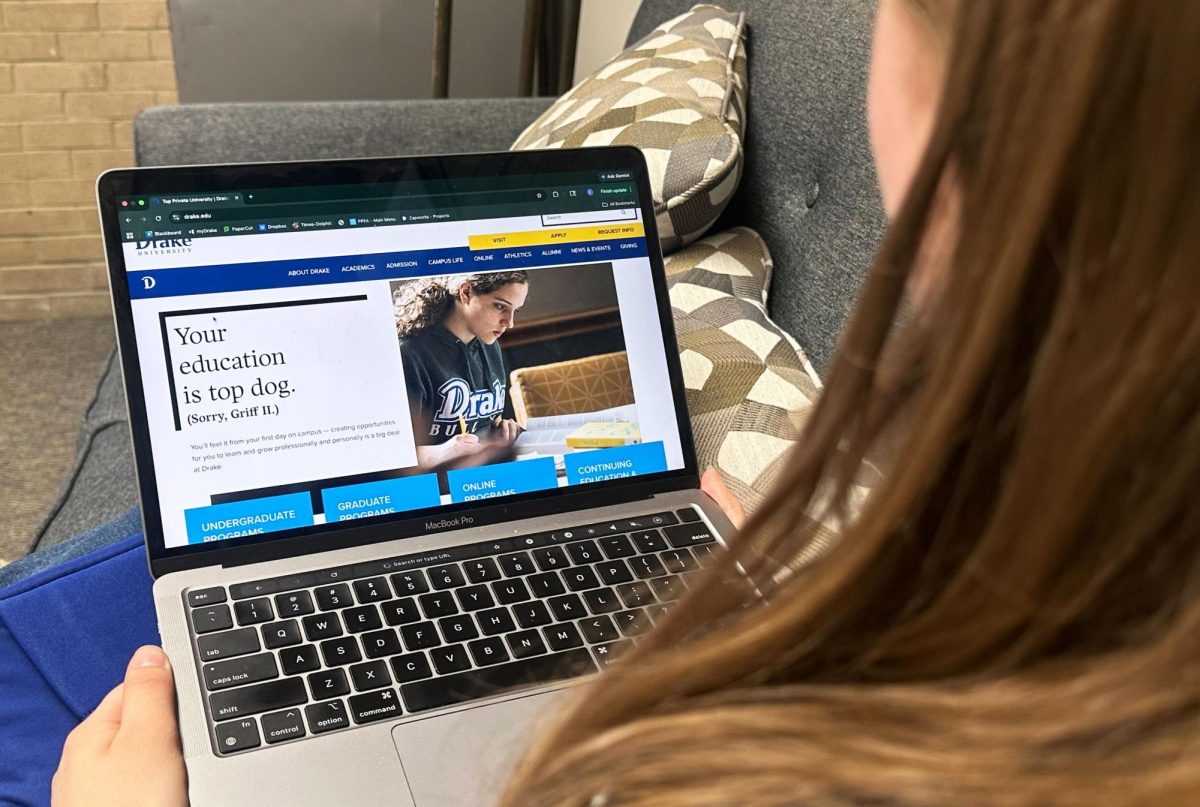
Drake University’s website will have a new look starting this summer. This marks the first website update in 12 years.
“Managed in a decentralized fashion, by 2024, the site had not only grown to more than 5,000 pages — many of which were outdated, duplicative, or contained errors — but more broadly, the site had significant room to grow in terms of accessibility and usability best practices,” said Leslie Maynes, executive director of University Communications and Marketing.
In May 2024, the Communications and Marketing team began receiving responses to a request for proposal for a website update project. That fall, they selected student connection company Carnegie as a partner based on previous experiences with them and affordability. From there, the team began website work. Previously, the website had undergone a major redesign roughly every two years, as displayed on the Wayback Machine.
The team is keeping prospective students and families in mind, with the goal of enrollment and a focus on usability and accessibility. The website will also have more tailored interactions for visitors.
“Our website has the highest traffic of any ‘building’ on campus and is the key gateway for prospective students and families independently researching Drake for their future academic career,” Maynes said.
Funding for the project came from the University Marketing and Communications budget, the University Advancement Budget and a University strategic fund. Early phases were led by Carnegie and done in collaboration with Information Technology Services.
To update the website, the team went through different phases. The “define” phase included focus groups with stakeholders and the development of a strategy for the update. The team also defined how they would manage the site by creating a governance plan.
The “design” phase focused on establishing a “creative direction” for the project, and from that, the team had what Maynes referred to as a “comprehensive, intuitive, and flexible design system based on an approved site structure and wireframes.” From this, the team created code that displayed their desired visual look and feel for site templates.
With the code, the team moved to the “implement” phase, where they audited 5,000 pages of current website content. This helped guide content development for the new site.
Currently, the team is in the “deploy” phase, where they are migrating all designated content to the new website structure.
“Partners in the colleges and schools are working diligently, as well, to move content that previously lived on the external site into internal site structures,” Maynes said. “ITS has been an incredible partner in helping guide the internal sites’ work.”
In the summer, the “transition” phase will conclude the update, when the new website will debut and the team will conduct tests to ensure the website’s long-term success.
Chris Snider, associate professor in the School of Journalism and Mass Communication, ran the Des Moines Register’s website and currently teaches courses on website development and design. He first heard about the redesign a couple of years ago, but hadn’t heard more information prior to March.
In his Digital Media Strategies class, Snider shows the students the current Drake website and models from previous years.
“Current students don’t tend to have positive things to say about Drake’s website when we talk about it in class,” Snider said. “But I remind them that it’s not built for that, right? It’s a big lift for a website to be all things to all people. And I think Drake focusing on prospective students probably makes the most amount of sense.”
While the current website has a well-placed and attention-grabbing picture as a strength, Snider said he believes the website is long overdue for an update.
Snider updates outdated pages for the SJMC’s site, such as course information or professor pages. He has seen fewer instances of people finding outdated information on the website in the past few years due to these minor tweaks.
“The website is a living, breathing document, and so you launch it and then you continue to improve it and change it,” Snider said.
Before and after the launch, Drake will communicate more information about the update with faculty, staff and students, said Maynes. This includes a way to access information on the governance plan, request site updates, create support tickets and find information previously housed on the site.
“For students, this means some information, such as forms and policies, will be moved from the external site to internal sites, and we’ll be communicating all this information prior to launch,” Maynes said.
The team is prioritizing first that the website works and then will shift to focus on “improvement and enhancements” that will come post-launch, said Maynes, especially in relation to artificial intelligence.
“We will then quickly need to move into Answer [Engine] Optimization work that improves Drake’s appearance in AI searches,” Maynes said. “While prospective students engage heavily with imagery and short-form content, AEO favors long-form content, so we’ll need to be working to address all ends of the content spectrum.”
Maynes said the University will allow the website to stay relevant as technology advances, and Maynes warned that there may be bumps in the road with the update.
“We’ll no doubt need some patience as we all work to gain comfort with the new site, and the new spaces where old content used to live on the new site,” Maynes said. “Websites take a while to build health once they’re launched, so we will be monitoring traffic and behaviors, but doing that against the reality that websites take some months to regain standing after launch.”