

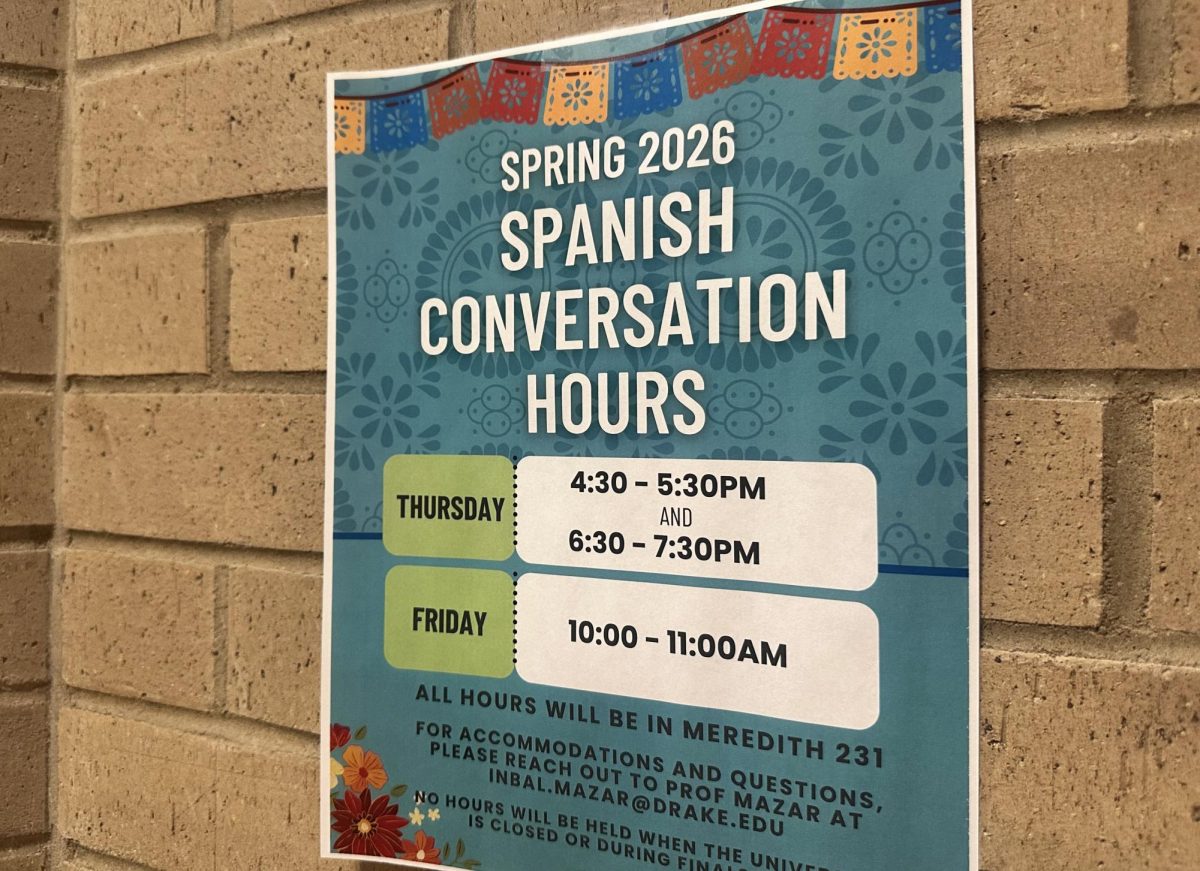
In a world of higher-ed academia, learning is characterized by test scores and homework assignments. However, this isn’t the case at Drake University’s Spanish Conversation Hours, a three-times-weekly program offered by the Department of World Languages and Culture.
“The goal is to have an informal space to chat and practice and learn about culture,” Inbal Mazar, associate professor of Spanish, said in an email interview.
Mazar took over the program in 2015 shortly after it began. The educational initiative was created and made open for any individual to practice speaking and listening in a relaxed setting, while learning about Spanish-speaking cultures.
The program holds two sessions on Thursdays from 4:30 to 5:30 and 6:30 to 7:30 p.m. Morning sessions on Fridays take place from 10 to 11 a.m. All sessions take place in Meredith Hall, Room 231.
Sally Haack, professor of pharmacy practice, said she encourages her healthcare students to attend the conversation hours because she guides them during their pharmacy rotations at a clinic in Des Moines called Primary Healthcare. Haack said that it is a community health center, and it serves a large Spanish-speaking patient population.
Haack has attended the sessions over the past several years to improve her own fluency in Spanish.
“For better or for worse, there’s no homework,” Haack said. “I think the biggest benefit for me is that it’s a super non-threatening environment. It’s super casual and just whatever topics you want to talk about, so I think that’s what keeps me coming back.”
Geonella Ramirez, a sophomore at Drake pursuing a minor in Spanish, said her professor, Mazar, pushed her and her classmates to attend the hours. Ramirez said she was excited to experience a session because she grew up speaking Spanish in her household. 22% of Des Moines residents speak a language other than English at home, according to the U.S. Census. For Ramirez, the hours offer a linguistic bridge between personal culture and her education.
“It’s always good to speak for an hour because obviously I’m not doing it here as I would at home,” Ramirez said. “This is a really nice opportunity. For example, my cousin, who attends [the University of Kansas], was telling me… ‘I [cousin] do not have anyone to speak Spanish with or a Spanish minor and I kind of wish I had that environment.’”
Ramirez was grateful that the environment of the sessions this semester has always been laid-back and welcoming, most often consisting of two to three students, including herself.
“There are two student conversation facilitators you can go with: Alan and Ian,” Ramirez said. “Sometimes they will have games or questions planned, like ‘What are you doing this weekend?’ Usually, topics revolve around us students at the time.”
Ian Subelman, a junior international student from Chile, is one of the two paid student workers who work to facilitate a helpful, non-intimidating Spanish-speaking environment.
“It’s not really teaching, but it’s more like practicing with them [students],” Subelman said. “And just making sure they are comfortable and encouraging them to talk about topics that they’re comfortable with.”
Subelman said his girlfriend introduced this job idea to him, prompting him to reach out to the professors who help run the conversation hours and set up a meeting. Ultimately, he said that what got him the role in his sophomore year was that Spanish is his native language and he understands others who are learning need patience and a friendly atmosphere.
“I don’t rush them [students] or anything,” Subelman said. “If there is a word they are looking for, I try to help them out. Like it will probably take a little time and effort – one hour of the day – but otherwise, if you want to learn, I’m here, I can help you out.”
According to the Drake World Languages and Culture website, learning another language and culture can benefit one in various ways in the outside world. From the language department to the pharmacy school, to even the college of business, learning other languages is a widely valued skill across Drake.
“Whatever your major is, it’s so important to have other skills related to language and cultural understanding,” Haack said. “I think everyone should just go and try it.”


