
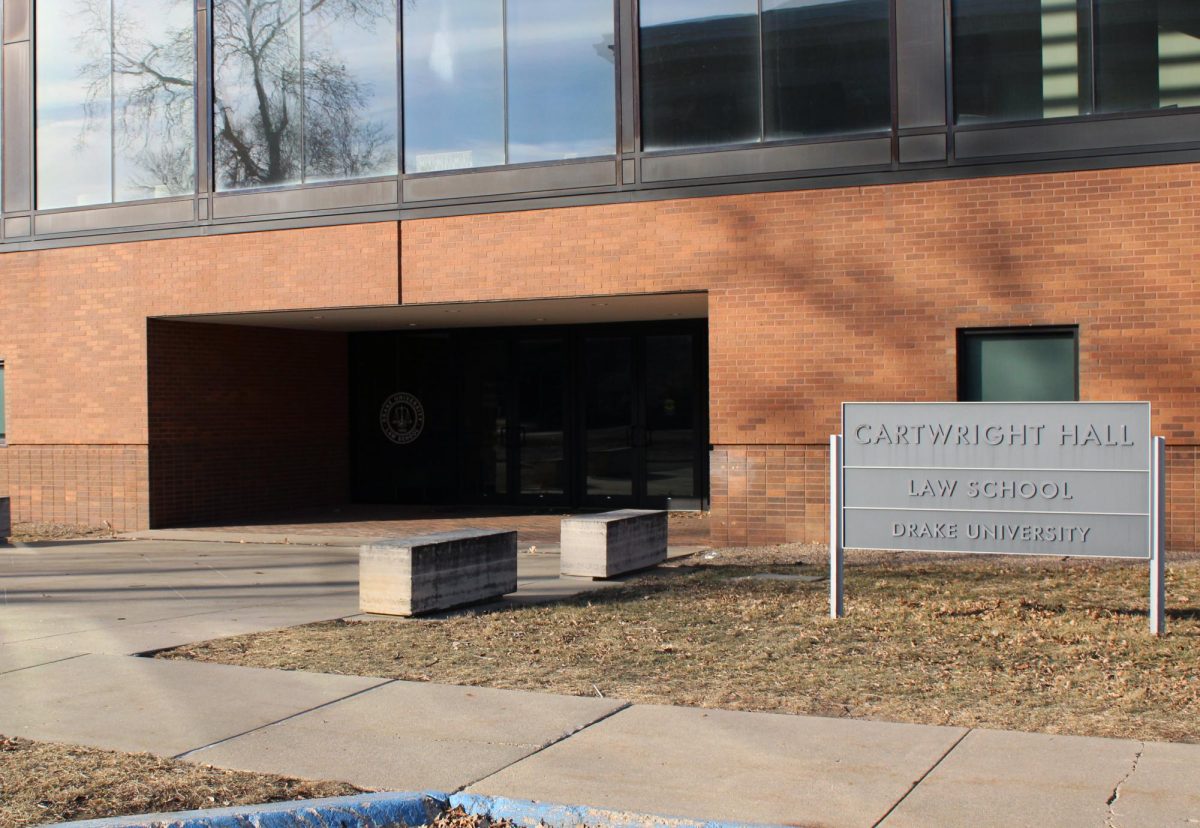
The Drake University Law School and the School of Education announced a new joint graduate program Jan. 29 that begins this fall.
“Law and education are closely connected,” said Law School Dean Roscoe Jones. “Law really establishes the kind of statutory and constitutional framework that really shapes educational equity; it shapes students’ rights, special education compliance — and by integrating all of those fields, leaders can thoughtfully design policies.”
Ryan Wise, dean of the School of Education, said that the landscape schools are facing is more complex. That shift is in part why Drake is offering this partnership.
“Decisions about curriculum, funding, assessment, technology, and student well-being are influenced by legal requirements and policy debates,” said Wise.
The program offers students the opportunity to earn a Juris Doctor degree from the Law School and either a Doctor of Philosophy in Education or a Doctor of Education in Leadership from the School of Education simultaneously. The joint program takes around five to six years, according to Drake’s website.
Current undergraduates, such as first-year law, politics, and society and accounting student Madeleine Cole-Dominguez, find this new program interesting and important.
“School is its own form of government,” said Cole-Dominguez.
Wise said he felt similarly to Cole-Dominguez during his time as a graduate student.
“Having this program as a graduate degree option would have offered a way to pursue both passions in a more intentional and integrated way,” Wise said.
Jones, who spent time working on both Capitol Hill and in higher education, agreed.
“It certainly could have benefited me having that experience, given all the pathways I’ve taken in my career,” Jones said.
Jones said that graduates of the program will be “bridging the gap between legal theory and day-to-day school operations” for the job market.
“Leaders who understand both the legal context and the educational implications can help schools respond with clarity, design better policies, and support students more effectively. The joint program prepares graduates to meet these needs,” Wise said.
Graduating from this program will equip students with these new skills and give them a wide range of career options.
“Students may take this, and they may say, ‘Hey, I want to go into higher education leadership,’ or, ‘I want to be a superintendent,’ or, ‘I want to work in public policy,’ or ‘I may just want to be a civil rights lawyer,’” Jones said.
This program is made possible through cross-credit courses. Interested students must apply to and be accepted by the Law School and the School of Education independently.