

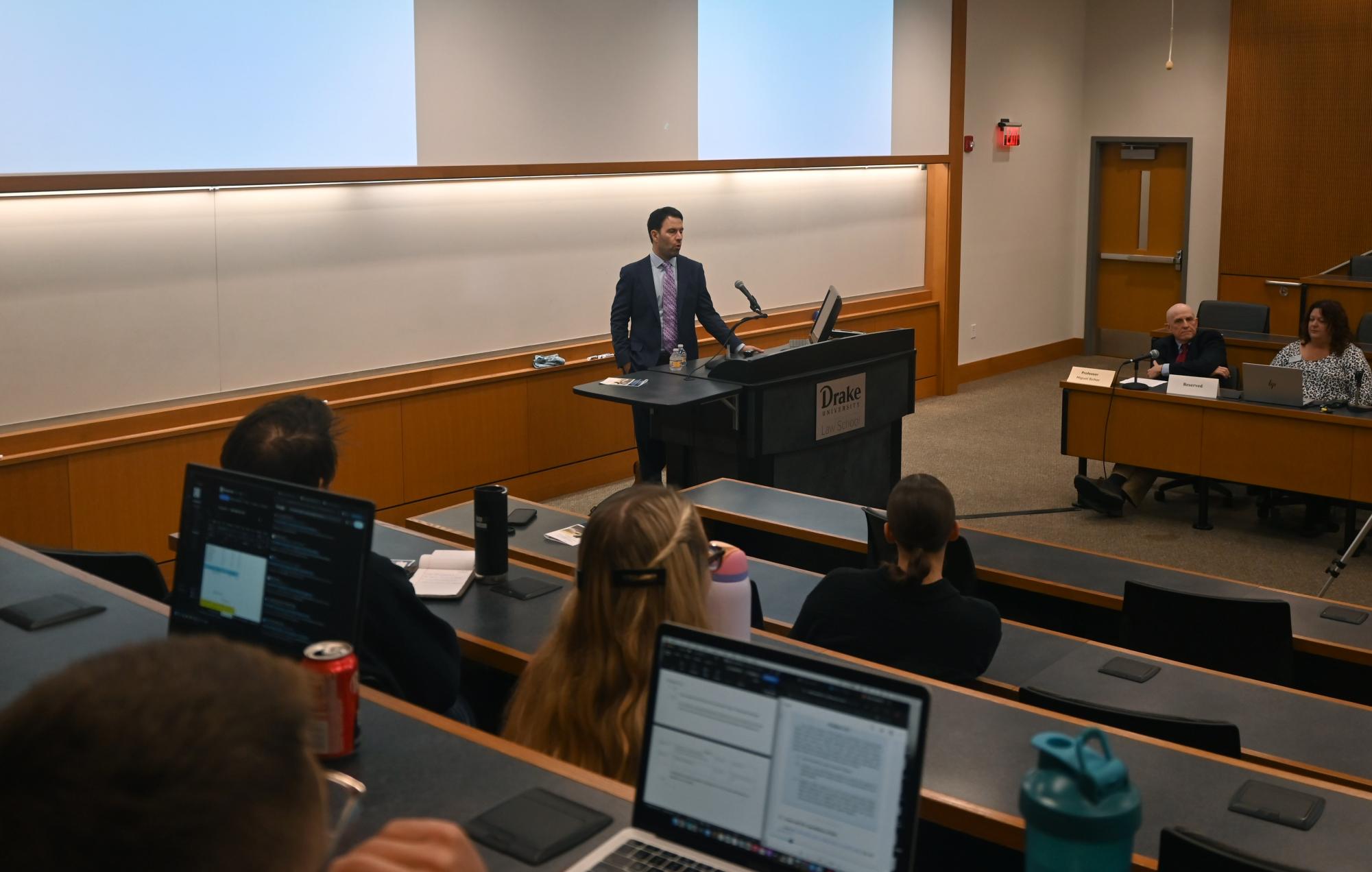
Drake Law School faculty kicked off the annual Constitution Day event on Sept. 20 at 3 p.m., welcoming Harvard Law School Professor Nicholas Stephanopoulos to open a dialogue about “Aligning Constitutional Law,” the title of his presentation.
Stephanopoulos’s theory of alignment “refers basically to the government doing what people want the government to do,” as he puts it.
Dean and Professor of Law Roscoe Jones Jr. opened the event with an overview of its history.
“Each year, Constitution Day gives us an opportunity not only to honor the document itself, but to engage with pressing questions about how constitutional law adapts to the challenges of our time,” Jones said. “Today’s lecture is part of that ongoing tradition of inquiry, reflection and dialogue.”
Professor of Law Miguel Schor provided background on guest speaker Stephanopoulos, detailing his scholarship as a graduate of Yale Law School, former professor at the University of Chicago and member of the American Law Institute.
“His scholarly work is wide-ranging, as he writes about the Constitution, election law, comparative law and democratic theory,” Schor said.
Interested audience members were encouraged to buy and read Stephanopoulos’s book, “Aligning Election Law,” recently published in 2024, which fleshes out a theory of alignment as an overarching election law principle, reflecting on what it might look like within constitutional and election law.
“This is kind of a tentative exploratory project. You might think of it as a project of constitutional imagination,” Stephanopoulos said. “I still think there’s a lot of value in this kind of scholarship — sketching out alternative constitutional visions for the country, even if those visions aren’t likely to be realized anytime soon.”
Given Stephanopoulos’s technical definition of alignment being “congruence between number one, governmental outputs, and two, popular preferences within a given political unit,” there are many different contextual applications of alignment and versions of what that looks like.
“The government wears a lot of different faces. And those different kinds of governmental activities give rise to different kinds of alignment,” Stephanopoulos said. “So, for example, elected officials have party affiliations. And so we can talk about the partisan alignment of the government.”
Stephanopoulos cited other examples of alignment or misalignment, such as when officials’ policy positions or their adopted policies either match or contradict public opinion.
Similarly, Stephanopoulos explained how alignment can be applied to people’s preferences. “Focus on the views of the median person,” describes majoritarian alignment. Collective alignment, in contrast, he said, describes a focus on all people’s preferences in relation to government outputs.
“My persuasive job would be a lot easier if we began with an alignment clause in the Constitution,” Stephanopoulos said. “But Article I and the 17th Amendment require the House and the Senate to be elected, quote, ‘by the people.’ And so people’s political preferences have a major role in the Constitution.”
Stephanopoulos said that the Constitution’s Article IV, Section IV ensures a republican government for each state, adding that republicanism can be viewed as synonymous with popular sovereignty, or popular rule.
He explained how support for alignment in the law is lastly seen within the 14th Amendment.
“The 14th Amendment requires equal protection for all persons,” Stephanopoulos said. “Of course, the Supreme Court has built this enormous, elaborate doctrinal edifice on the basis of the equal protection clause. But at bottom, the equal protection clause contains an equality norm.”
Under Stephanopoulos’s framework, he also explained what alignment looks like within media coverage.
“Less media coverage of policies and also governmental measures that reduce the quality or the quantity of media coverage. Those are misaligning because what they do is they reduce the electoral penalty faced by politicians who are out of step with their constituents,” Stephanopoulos said. “When you have more media coverage or policies that increase media coverage, there’s more of a penalty for being out of line with what your constituents want.”
As someone who has “long been interested in the kinds of questions that drove the framers when they wrote the Constitution,” Schor embraces opportunities to not only honor the Constitution, but reflect on it.
“It strikes me that the Constitution is a way of having a conversation between people who disagree and sometimes disagree very loudly,” Schor said. “We’re facing a lot of headwinds in our nation and this is part of the solution – is thinking our way, puzzling through the Constitution.”
Attendee Lauren Benson is much newer to the law scene, as she just recently graduated from Drake with a sociology degree and is exploring her interest in going to law school. She found the event the day of, looking on Drake’s website.
“There’s people who want to engage in an ongoing dialogue about the Constitution and how it affects everyday life for Americans,” Benson said. “This gives people space to do that and talk to professionals who have formed evidence-based reasons for what they believe. So I think that that’s valuable and that it’s free and accessible.”
After hearing Stephanopoulos’s presentation and the dialogue opened in the following Q&A, Benson does feel she’s “more interested after this conversation.”
“I like the fact that right now this is a big puzzle to me,” Benson said. “Each thing that I learned, it gets me a little bit closer to understanding. So it’s a cool challenge.”
With Schor’s own students, he encourages learning how to think critically about the constitution in an analytical sense, “the same way that you do in all your classes when you’re in college.”
“What’s wrong with being critical?” Schor said. “The framers didn’t exactly venerate the Articles of Confederation that they were getting rid of. They understood that sometimes we have to have really hard discussions about whether or not things are working.”